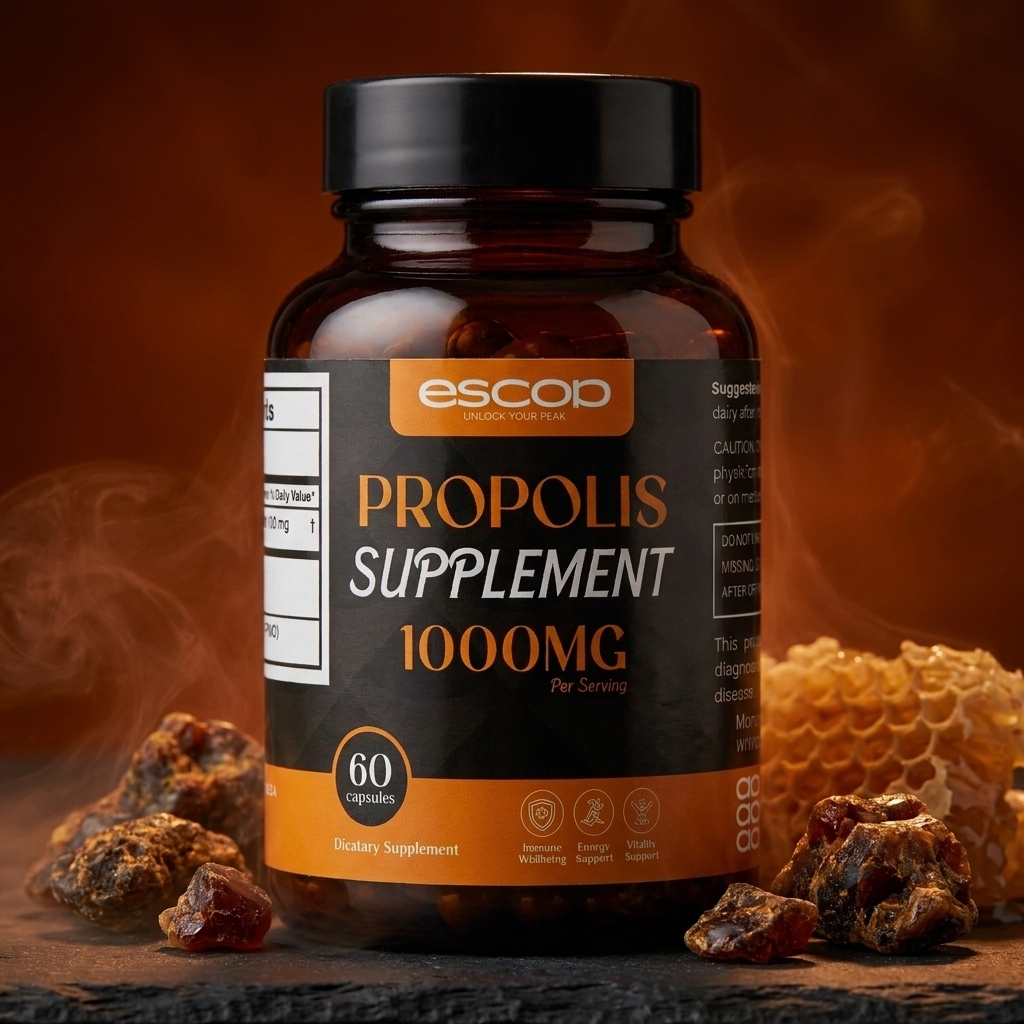
Propolis is one of the most sought-after hive products in Morocco as soon as the first cold days arrive, alongside honey and royal jelly. This brown resin, collected by bees from tree buds and bark, has been used since antiquity to soothe the throat and support the body’s natural defences. But what does research actually say about its composition, its properties, its dosage and its limits? Here is a complete, fact-based overview.

What is propolis?
Propolis is a resinous substance made by bees from plant resins they collect from the buds and bark of certain trees: poplar, pine, oak and cypress. Worker bees mix it with their wax and secretions. In Morocco it is known by its Arabic name العكبر (al-‘akbar).
Inside the hive, it plays a dual role as both sealant and disinfectant: bees use it to line the walls, seal cracks and sanitise the cells before the queen lays her eggs. It is precisely this protective function that caught researchers’ attention.
Its colour ranges from light yellow to almost black brown, depending on the trees visited and the harvesting region. A Moroccan propolis from Mediterranean flora will therefore not have exactly the same chemical profile as Brazilian green propolis or European poplar propolis. This variability is key to understanding what follows.
Composition and active compounds of propolis
Raw propolis has a fairly stable overall composition:
- around 50% plant resins;
- 30% waxes;
- 10% essential oils and aromatic compounds;
- 5% pollen;
- 5% other organic and mineral substances.
More than 300 different molecules have been identified to date in the propolis samples analysed: phenolic acids, flavonoids, terpenoids, benzofurans and chalcones. It is this richness, rather than a single isolated active ingredient, that explains the scientific interest in this resin.
Flavonoids are the most studied family. They include quercetin and galangin, to which the literature attributes antioxidant, anti-inflammatory and antimicrobial properties. Another compound that comes up regularly in publications is CAPE (caffeic acid phenethyl ester), which is particularly well documented for its antioxidant activity.
Key takeaway: polyphenol content varies greatly from one batch to another. That is why titrated or standardised extracts offer a consistency that raw resin does not always guarantee.
7 benefits of propolis
1. Classic support for the throat
This is the most widespread use, and the one with the most ready-to-use forms: sprays, lozenges and chewing gums. Propolis is traditionally used for an irritated throat or discomfort in the upper respiratory tract, especially during the cold season.
2. Support for natural defences
Immunomodulatory activities have been reported in the scientific literature. This explains the popularity of propolis courses at the start of autumn and winter, often combined with honey or vitamin C.
3. Antibacterial and antifungal activity
Published studies describe antibacterial, antiviral and antifungal activities, attributed mainly to phenolic compounds. These results come largely from laboratory studies: they explain the interest in propolis, but do not make it a substitute for anti-infective treatments.
4. An ally for oral health
This is one of the best-documented areas. Clinical studies suggest that propolis may help reduce micro-organisms in dental biofilm and limit its formation, with possible benefits for dental plaque, gingivitis and tooth decay. It is also being researched in endodontics.
5. Strong antioxidant power
Its high polyphenol content gives propolis strong antioxidant activity, measured in numerous studies. Antioxidants help the body limit oxidative stress, a mechanism involved in cellular ageing.
6. An anti-inflammatory effect
Flavonoids are among the compounds most studied for their anti-inflammatory effects. This underpins the traditional use of propolis for local irritations, particularly of the ear, nose and throat and the mouth.
7. Traditional use on the skin
Balms, ointments and so-called “white” propolis are applied externally to minor skin irritations. A patch test beforehand is essential here, as propolis is a known allergen.
How to use propolis: forms and dosage
The dosage of propolis depends entirely on the form chosen and the concentration of the product. The most commonly cited guidelines are as follows:
- Mother tincture / hydroalcoholic extract: 20 to 40 drops a day for adults, or 20 to 30 drops 2 to 3 times a day, diluted in a little lukewarm water or herbal tea.
- Raw propolis to chew: about 1 g, 1 to 3 times a day, for respiratory discomfort.
- Capsules and tablets: typically 100 to 800 mg a day, depending on the concentration of the extract.
- Spray or lozenges: local, occasional use, strictly following the manufacturer’s instructions.
As for duration, the most common recommendation is to take courses of 2 to 3 weeks maximum, followed by a break. This limit is intended in particular to reduce the risk of gradual allergic sensitisation.
Two practical tips: propolis dissolves poorly in water alone, hence the alcohol- or glycerine-based extracts; and the dosage on the packaging always takes precedence over the general guidelines above, as concentrations vary enormously from one brand to another.
Propolis precautions and contraindications
Propolis is generally well tolerated, but it is one of the most allergenic natural products. Points to watch:
- Allergy to hive products (honey, pollen, royal jelly, bee venom): the main contraindication. If in doubt, apply a drop to the inside of the elbow and wait 24 hours before any use.
- Allergy-prone individuals or asthma: propolis, whether inhaled or ingested, can trigger or worsen a respiratory reaction. Advice from a healthcare professional is necessary.
- Pregnancy and breastfeeding: clinical data are insufficient to guarantee safety. Seek medical advice before any use.
- Young children: particular caution under the age of 3.
- Possible side effects: skin reactions (contact eczema, redness), mouth irritation, and more rarely respiratory reactions.
Finally, if you are taking medication or are under medical care, tell your doctor or pharmacist about any food supplement you take.
Frequently asked questions about propolis
What is the difference between propolis, honey and royal jelly?
Honey comes from nectar transformed by bees; royal jelly is a glandular secretion intended for the queen and the larvae; propolis, for its part, is a plant resin that is collected and then reworked, and whose role in the hive is structural and protective. Three products, three compositions, three distinct uses.
Can I take propolis all year round?
That is not the recommended use. The most common practice is to take courses of 2 to 3 weeks, separated by breaks, rather than continuous intake, in order to limit the risk of sensitisation.
How can I recognise good-quality propolis?
Look at the origin of the harvest, any stated titration of polyphenols or total flavonoids, transparency about the extraction solvent and the harvest date. Raw propolis should be firm and brittle when cold, soft and sticky in the warmth of your fingers, with a distinct resinous smell.
In summary
Propolis is a remarkably rich hive product: more than 300 molecules, a high flavonoid content and well-documented antioxidant activity. It is traditionally used for the throat, natural defences and oral hygiene. Its two main limitations are the variability of its composition depending on its origin and its allergenic potential, which calls for a patch test and rules it out for anyone allergic to hive products.
Further reading
- Propolis — encyclopaedia entry (Wikipedia)
- Liquorice: benefits, dosage and precautions
- Eucalyptus: benefits, dosage and precautions
- Green tea: benefits, dosage and precautions
This article is for information only and does not replace medical advice. If symptoms persist, or if you are pregnant, breastfeeding, taking medication or prone to allergies, consult a healthcare professional before using propolis.