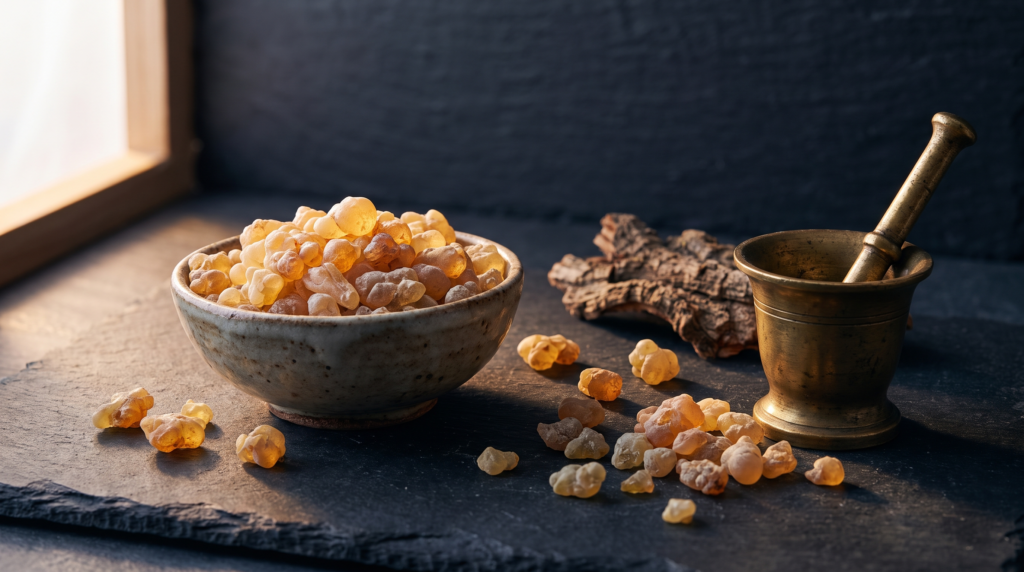
Boswellia, known in Morocco as louban dkar and in English as olibanum or frankincense, is an aromatic gum resin used since antiquity both for fumigation and for its medicinal uses. Long confined to souks and household rituals, it now occupies a growing place on dietary supplement shelves, driven by genuine scientific interest in its boswellic acids and their action on joint comfort. Here is what we know about its composition, its benefits, the useful dosage and the precautions to follow.
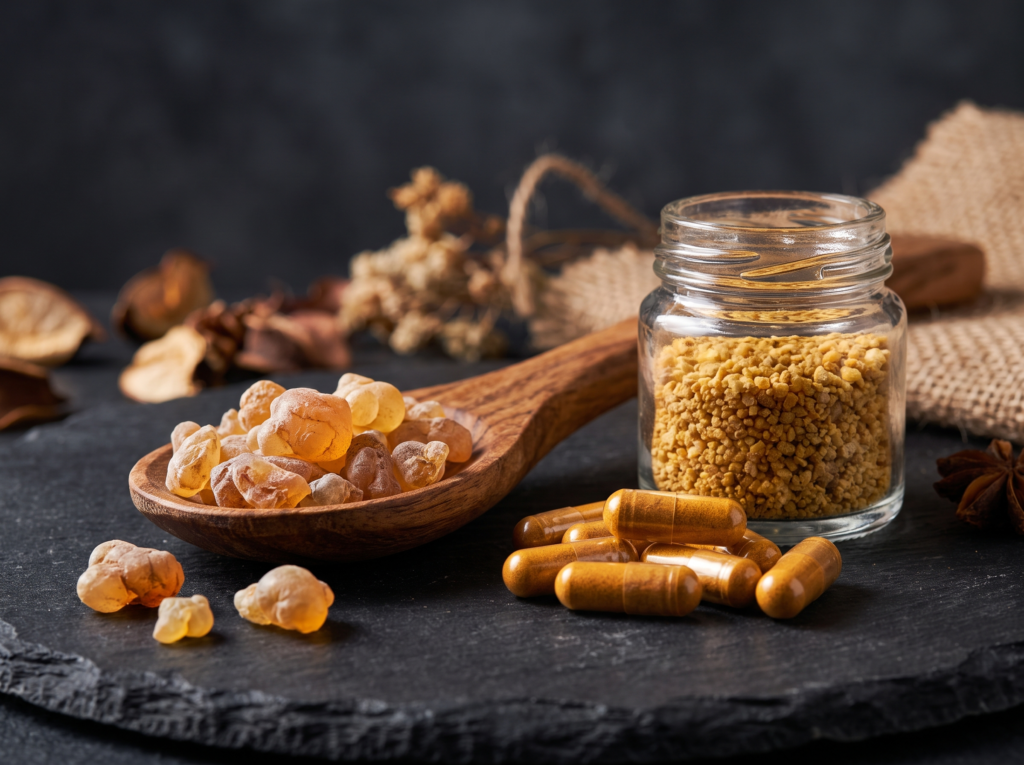
What is boswellia (louban dkar)?
Boswellia is a genus of trees in the Burseraceae family, growing in the arid regions of the Horn of Africa, the Arabian Peninsula and India. When the bark is cut, an exudate is collected that hardens in the air into amber “tears”: this is the oleo-gum resin, frankincense proper.
Several species are harvested. Boswellia serrata, native to India, is the most studied in modern herbal medicine and the most common in dietary supplements. Boswellia sacra (or carterii), from Oman, Somalia and Yemen, provides the frankincense most prized in perfumery and fumigation — it is the one most often found at Moroccan herbalists under the name louban dkar.
In Morocco, louban has a twofold traditional use: the resin is burned on charcoal to perfume and purify the air in homes, and it is taken internally as a decoction or maceration, a practice handed down from classical Arab-Islamic medicine.
Composition and active compounds of boswellia
The oleo-gum resin can be roughly divided into three fractions:
- The gum: about 65% of the whole, made up of water-soluble polysaccharides.
- The resin: the most interesting fraction pharmacologically, rich in triterpene acids known as boswellic acids.
- The essential oil: 5 to 10%, responsible for the characteristic balsamic scent.
Boswellic acids and AKBA
Among the hundred or so compounds identified, boswellic acids attract the most attention. The most studied is acetyl-11-keto-β-boswellic acid, abbreviated AKBA. Its mechanism is well characterised: it inhibits 5-lipoxygenase (5-LOX), the enzyme that drives the synthesis of leukotrienes, mediators involved in inflammatory processes. Some studies indicate that AKBA alters the enzyme’s structure in a way that redirects lipid production towards anti-inflammatory mediators.
AKBA content varies greatly by species: it has been measured at about 7% in Boswellia sacra compared with about 0.7% in Boswellia serrata. This is why serrata-based supplements are offered as standardised extracts, to guarantee a consistent concentration of active compounds.
The health benefits of boswellia
The body of scientific evidence remains moderate in size, with clinical trials that are often short and involve small numbers of participants. The following areas are nevertheless the best documented.
1. Joint comfort
This is the flagship indication. In a placebo-controlled trial, subjects who received a standardised Boswellia serrata extract for 120 days showed improvements in walking distance, flexibility and joint comfort. Other studies report reduced pain and better joint function after 8 to 12 weeks of use.
2. Cartilage preservation
Beyond symptom relief, boswellia extract inhibits in vitro several enzymes that break down the cartilage matrix: collagenase, elastase and hyaluronidase. This action may explain the decrease in markers of joint damage observed in some studies.
3. An overall anti-inflammatory action
Inhibition of 5-LOX sets boswellia apart from most conventional anti-inflammatories, which instead target the cyclo-oxygenase pathway. This different mode of action explains the interest in the plant for chronic inflammatory conditions.
4. Respiratory comfort
Leukotrienes play a role in bronchial reactivity. This pharmacological rationale has prompted several exploratory studies on asthma, with results that are preliminary but consistent with the traditional use of frankincense fumigation.
5. Digestive comfort
Traditional medicine uses olibanum to soothe digestive complaints. Research has looked at inflammatory bowel diseases, but the data remain too limited to support a firm recommendation.
6. Cosmetic and oral care use
The resin is included in skincare preparations, and in Moroccan tradition it is chewed for oral hygiene and fresh breath — an ancient practice shared with mastic gum.
How to use boswellia and dosage
The doses from clinical trials relate to standardised extracts, not raw resin. The distinction matters: a frankincense tear bought at the souk does not provide the same concentration of boswellic acids as a titrated capsule.
- Standardised extract: titrated at 30–65% boswellic acids, the indicative dosage is 100 to 300 mg, 2 to 3 times a day. Studies on joint comfort use a range of 100 to 500 mg per day.
- Duration: allow 8 to 12 weeks to assess the effect; some protocols extend to 120 days.
- When to take it: since boswellic acids are fat-soluble, taking them with a meal containing a little fat improves their absorption.
- Raw resin: as a maceration or light decoction, following traditional use — with no standardised dosage, so in moderation.
- Fumigation: a few tears on charcoal, in a ventilated room. Burning produces fine particles: avoid prolonged exposure in enclosed spaces, especially around children or people with asthma.
When buying, choose an extract that states the botanical species and the standardisation level. For the resin, choose translucent, amber tears with a clear balsamic scent, stored away from heat.
Precautions and contraindications
Boswellia is generally well tolerated at the doses studied, but a few situations call for caution.
- Pregnancy and breastfeeding: due to a lack of safety data, use as a supplement is not recommended.
- Children: reserve use for adults, unless advised otherwise by a doctor.
- Ongoing treatments: boswellic acids may interfere with the metabolism of certain medicines. Medical or pharmacist advice is essential, particularly if you take anticoagulants, anti-inflammatories or immunosuppressants.
- Planned surgery: it is best to stop taking it several days before the operation.
- Side effects: the most commonly reported are digestive and mild — nausea, heartburn, diarrhoea. Allergic skin reactions are possible.
Finally, a useful reminder: persistent joint pain, prolonged morning stiffness or swelling warrant a medical diagnosis before any self-medication with plants.
FAQ: your questions about boswellia
Is louban from the souk equivalent to a boswellia capsule?
No. Raw resin is about two-thirds gum, and its boswellic acid content varies with species, origin and harvest. Capsules rely on a concentrated, titrated extract, which makes the dose reproducible — and it is this form that has been evaluated in clinical trials.
How long does it take to feel an effect?
The most conclusive protocols run for 8 to 12 weeks, sometimes 120 days. It is not a fast-acting painkiller: regular use matters more than any single dose.
Can boswellia be combined with other plants?
Combinations with turmeric or ginger are common in formulas for joint comfort, each acting on different inflammatory pathways. Combining several active ingredients does, however, increase the risk of interactions: seek advice before combining several supplements.
In summary
Boswellia is a good example of a thousand-year-old traditional use meeting an identifiable modern pharmacology: the inhibition of 5-LOX by AKBA provides a clear mechanism, and trials on joint comfort are encouraging without being conclusive. To benefit from it, keep two habits: choose an extract that states its species and titration, and give the course enough time. Louban burned at home keeps its own role — that of a fragrance and a ritual, to be enjoyed in a well-aired room.
Further reading
- Reference page on the resin: Frankincense (olibanum) on Wikipedia
- Turmeric: benefits, dosage and precautions
- Ginger: benefits, dosage and precautions
- Nettle: benefits, dosage and precautions
This article is for information only and does not replace medical advice. Ask a healthcare professional for advice before any course, especially if you are pregnant or breastfeeding, have a chronic illness or are undergoing treatment.