Echinacea is now one of the most sought-after plants for anyone looking to support their immune defences naturally as the cold season approaches. Native to North America, it has earned its place in Moroccan herbal shops and supplement aisles alongside thyme, propolis and ginger. But what do we really know about its composition, its benefits and its limits? Here is a complete, factual guide with no exaggerated promises.
What is echinacea?
Echinacea is a genus of herbaceous plants in the Asteraceae family, the same family as chamomile and artichoke. Three species are used in herbal medicine:
- Echinacea purpurea — purple echinacea, the most widely cultivated and studied species; mainly its flowering aerial parts are used.
- Echinacea angustifolia — narrow-leaved echinacea, used mainly for its root.
- Echinacea pallida — pale echinacea, also used for its root.
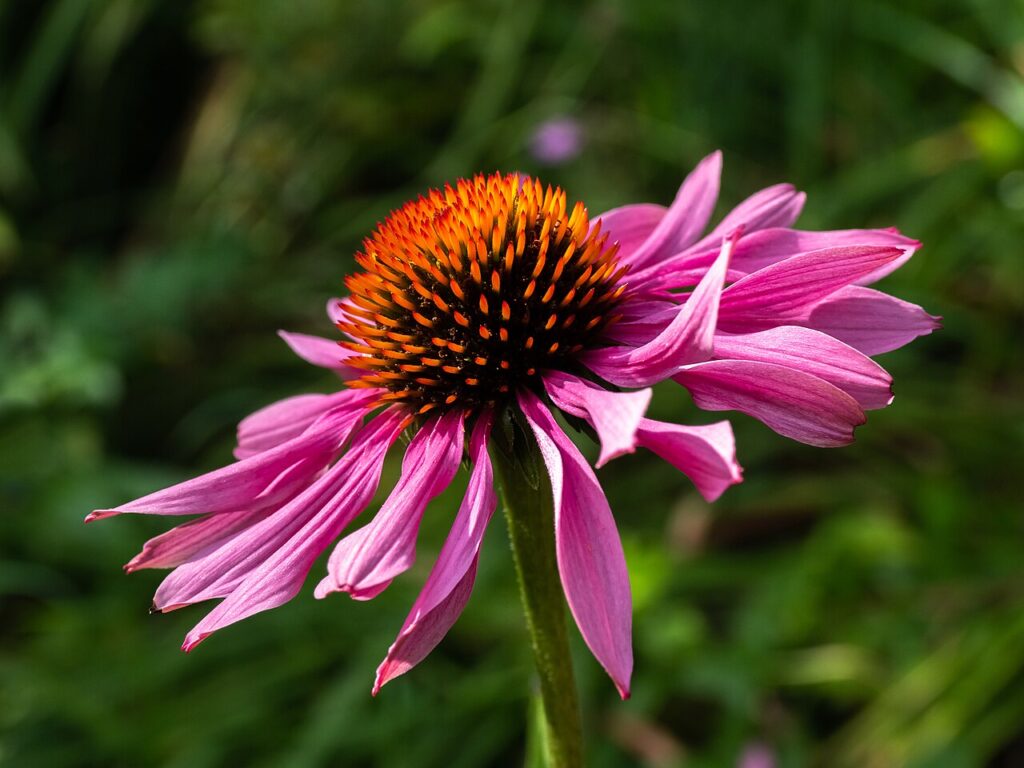
Its large mauve flowers with a domed centre earned it the name “purple coneflower”, or simply coneflower. Traditionally used by Native American peoples for wounds, bites and respiratory complaints, it was introduced to Europe in the 20th century, where it is now one of the best-selling medicinal plants.
Composition and active compounds of echinacea
The value of this plant does not rest on a single molecule but on a group of compounds that work in synergy. Phytochemical analyses mainly identify:
- Alkylamides (or alkamides): lipophilic compounds, around fifteen of which have been identified, particularly concentrated in the root. They are responsible for the slight tingling sensation on the tongue that is characteristic of a good-quality tincture.
- Caffeic acid derivatives: cichoric acid and caftaric acid, specific to Echinacea purpurea, plus echinacoside in the angustifolia and pallida species.
- Complex polysaccharides: arabinogalactans, fucogalactoxyloglucans and other high-molecular-weight chains, found mainly in the aerial parts.
- Flavonoids, glycoproteins and essential oils, in smaller amounts.
This composition varies considerably depending on the species, the part of the plant used, the extraction method and the harvest season. That is why two echinacea products can have very different profiles: a hydroalcoholic extract concentrates the alkylamides, while a water-based infusion extracts more of the polysaccharides.
The benefits of echinacea
Support for the immune system
This is the best-documented use. In vitro and animal studies show that Echinacea purpurea extracts stimulate the activity of key innate immune cells, notably macrophages and Natural Killer (NK) cells, and modulate the expression of certain genes involved in the immune response. It is described as having an immunostimulant and immunomodulating effect rather than a one-off “quick boost”.
Colds and seasonal respiratory infections
Several randomised, double-blind, placebo-controlled trials have observed a lower daily number of cold symptoms in the echinacea group, with the difference becoming significant from the third day. Other studies, however, found no clear difference compared with placebo. Systematic reviews generally conclude that the evidence remains limited and of variable quality, partly because of the wide variety of preparations tested. In other words, a modest effect on the duration and intensity of symptoms is plausible, but echinacea is not a treatment for the common cold.
Anti-inflammatory and antioxidant properties
In the laboratory, alkylamides and caffeic derivatives show antioxidant activity and an ability to modulate the production of inflammatory mediators such as interleukin-8. These findings explain the interest in the plant beyond the immune system alone, although they have yet to be confirmed in humans.
Traditional use on the skin
External use is the oldest: preparations made from the fresh juice or the root were applied to small wounds, cracked skin and skin irritations. Today, echinacea extract is found in soothing creams and balms, often combined with aloe vera or calendula.
How to use echinacea and dosage
The plant is taken in several forms, each with its own advantages:
- Infusion: about 1 to 2 g of dried aerial parts per cup of simmering water, steeped for 10 minutes, up to three cups a day. Herbaceous, slightly bitter taste.
- Root decoction: the root, which is woodier, needs gentle simmering for 10 to 15 minutes.
- Mother tincture or hydroalcoholic extract: the traditional form, diluted in a little water. Follow the manufacturer’s dosage carefully, as concentrations vary from one product to another.
- Capsules of dry extract or whole powder: the most convenient form for a course, with a standardised dose.
- Topical use: creams and balms, applied locally to clean skin.
Length of a course
Two approaches are commonly used. For prevention, it is taken in intermittent courses: 2 to 3 weeks per month over 2 to 3 months, typically at the start of autumn and winter. As an acute course, it is started at the very first signs (sore throat, runny nose) at a higher dose and for a short period.
In all cases, it is not recommended to continue taking it for more than 8 consecutive weeks without medical advice. Continuous, prolonged use has no proven benefit and, according to some hypotheses, could reduce the desired response.
Precautions and contraindications
Although well tolerated by most healthy adults, echinacea is not without risks:
- Autoimmune diseases: multiple sclerosis, lupus, rheumatoid arthritis… Its action on the immune system may worsen symptoms. Avoid.
- Immunosuppressive treatments: after a transplant or as part of treatment for a chronic inflammatory disease, the plant may interfere with the treatment. Medical advice is essential.
- Allergy to Asteraceae: people allergic to ragweed, chrysanthemum, chamomile or daisies risk cross-reactions, sometimes affecting the skin.
- Pregnancy and breastfeeding: as a precaution, and in the absence of sufficient data, use is not recommended.
- Young children: avoid in infants and young children without the advice of a healthcare professional.
- Possible side effects: mild digestive upset, nausea, skin rashes and, more rarely, allergic reactions.
Finally, product quality is crucial. Choose a product with a clearly stated botanical origin (species and part of the plant), a standardised extract and packaging that protects it from light.
Echinacea FAQ
When should you start a course of echinacea?
The most logical time is the start of the cold season, or any period of seasonal fatigue and increased exposure to respiratory viruses (back to school, travel, communal living). As an acute course, it is taken as soon as the first symptoms appear.
Can echinacea be combined with other plants?
Yes, classic combinations include propolis, thyme, ginger, elderberry or natural vitamin C. However, avoid stacking several immunostimulant supplements without supervision, especially if you are already on treatment.
Root or aerial parts: what is the difference?
The root is richer in alkylamides, while the aerial parts are richer in polysaccharides and cichoric acid. Many products combine both to cover the plant’s full phytochemical profile.
Conclusion
Echinacea holds a solid place among immune-support plants: its composition is well characterised, its traditional use goes back a long way, and the clinical data, though uneven, lean towards a modest effect on cold symptoms. It fits into an overall approach — sleep, diet, physical activity — rather than replacing it. Used in intermittent courses, with a quality product and with due respect for the contraindications, it is a sensible ally for the cold season.
Further reading
- Full botanical profile on Echinacea (Wikipedia)
- Propolis: benefits, dosage and precautions
- Thyme: benefits, dosage and precautions
- Spirulina: benefits and use
This article is provided for information purposes only and does not replace medical advice. If you have an illness, are undergoing treatment, or are pregnant or breastfeeding, consult a doctor or pharmacist before taking any dietary supplement.