Rhodiola is an adaptogenic plant increasingly sought after by people looking to better manage fatigue, stress and poor concentration. Native to cold, mountainous regions, it has been used for centuries in Russian and Scandinavian traditions, and today it is available as a dietary supplement, mainly in capsules and extracts. Here is what you need to know about its components, its studied effects, how to use it and its precautions.
What is rhodiola?
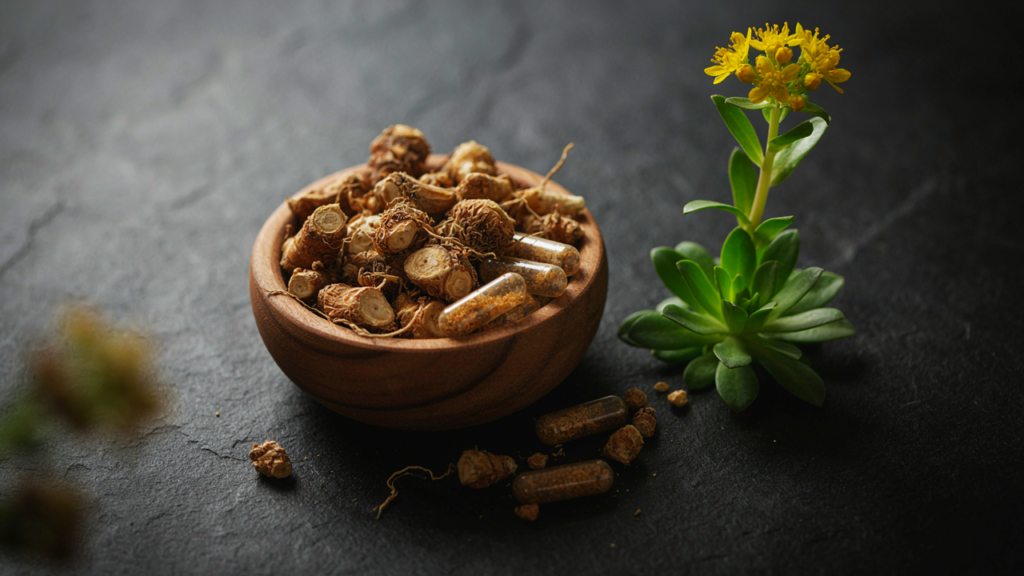
Rhodiola rosea, also known as roseroot or golden root, is a perennial plant of the Crassulaceae family. It grows in the cold regions of the Northern Hemisphere (the Arctic, the Alps, Scandinavia, the Rocky Mountains), sometimes at altitudes of up to 3,000 metres. A dioecious plant, it forms stems 5 to 35 cm tall.
It is mainly the root and rhizome that are used. In Russia and Scandinavia, rhodiola has traditionally been used to better withstand harsh climates and physical exhaustion. It is classed among the so-called “adaptogenic” plants, meaning plants traditionally used to help the body adapt to stress.
Composition and active compounds of rhodiola
Rhodiola root contains several families of compounds. The most frequently cited are:
- rosavins (rosavin, rosin, rosarin), characteristic of the species Rhodiola rosea;
- salidroside and tyrosol, two phenolic compounds;
- various polyphenols, including proanthocyanidins, quercetin and gallic acid.
These substances are thought to act synergistically rather than in isolation, which explains why extracts are often standardised for rosavins and salidroside.
The benefits of rhodiola
Against fatigue
This is its best-known use. Studies report reduced fatigue after about four weeks of regular use of a rhodiola extract, particularly in people under prolonged stress.
Better stress management
As an adaptogenic plant, rhodiola is used to support the body in the face of everyday stress and periods of overwork. Results vary from person to person and depending on the extract used.
Concentration and mental performance
Improved concentration has been observed in healthy subjects and in people suffering from burnout. It is sometimes used during exam periods or times of heavy workload.
Mood and morale
Some research has studied rhodiola extracts in mild to moderate depressive states, with notable effects. It is in no way a substitute for prescribed treatment: if you are experiencing psychological distress, consult a healthcare professional.
Physical performance: inconclusive results
Despite its reputation among athletes, studies on physical performance have not produced conclusive results. It is therefore wise to be cautious about marketing claims.
How to use rhodiola and dosage
Rhodiola is mainly taken as dry extract capsules or tablets, but also as a tincture or root powder. The dose depends on the concentration of the extract: always follow the dosage stated on the product packaging or recommended by a healthcare professional. In studies on mood, extracts dosed at between 340 and 680 mg per day were used.
- Take rhodiola early in the day to avoid possible sleep disturbances.
- Opt for courses of a few weeks, then take a break.
- Choose a quality product that clearly states the species Rhodiola rosea.
Precautions and contraindications
At the doses tested, no major side effects have been reported, but caution is still advised:
- Sleep disturbances, nervousness or irritability may occur if it is taken in the evening.
- It may interact with certain medications, particularly antidepressants: ask your doctor or pharmacist for advice.
- Due to insufficient data, it is not recommended during pregnancy and breastfeeding.
- People with bipolar disorder or marked anxiety should seek medical advice before taking it.
FAQ about rhodiola
When should you take rhodiola?
The morning or early in the day is the most recommended time, to limit the risk of disrupting sleep.
How long does rhodiola take to work?
Studies on fatigue and stress mention effects observed after about four weeks of regular use. However, the response varies from one person to another.
Can rhodiola be combined with other plants?
It is sometimes combined with other adaptogens or relaxing plants, but it is best to ask a professional for advice to avoid unsuitable combinations.
Conclusion
Rhodiola is a valuable adaptogenic plant for supporting the body in times of fatigue and stress, with effects documented mainly on fatigue and concentration. Its results on physical performance remain inconclusive, and its use calls for precautions, particularly if you are taking medication, are pregnant or are breastfeeding. Choose a quality product and seek advice before starting a course.
Further reading
- External source: the Wikipedia page on Rhodiola rosea
- Read also: ashwagandha
- Read also: the benefits of ginseng
- Read also: the benefits of spirulina
Disclaimer: this article is for information only and does not replace the advice of a doctor or healthcare professional.