Arugula (also known as rocket), called jarjir (الجرجير) in Morocco, is much more than a peppery salad leaf: it is a plant of the Brassicaceae family that has been used since antiquity both on the plate and in traditional care. In Moroccan herbal shops it comes in three distinct forms: fresh leaves, small brown seeds and, above all, arugula seed oil, which is in high demand for strengthening hair. This article reviews its composition, benefits, how to use it and the precautions to know before consuming it regularly.
What is arugula (jarjir)?
Arugula is an annual plant whose botanical name is Eruca vesicaria subsp. sativa (often referred to as Eruca sativa). It belongs to the Brassicaceae family, the same as cabbage, radish, watercress and mustard — which explains its sharp, slightly sulphurous aroma, characteristic of this botanical family.
Native to the Mediterranean basin and the Near East, it grows wild on poor, well-drained soils. In the Maghreb, a distinction is commonly made between cultivated arugula, with broad leaves and a mild taste, and wild arugula (often Diplotaxis tenuifolia), with more deeply cut leaves and a much stronger flavour.
In Moroccan tradition, jarjir is eaten raw in salads, but it is above all its seeds that interest herbalists: cold-pressed, they yield a golden-yellow to brown oil with a marked sulphurous smell, sold under the name zit el jarjir and renowned for hair care.
Composition and active compounds of arugula
The value of this plant lies in an unusual combination of sulphur compounds, vitamins and minerals, for a very low calorie intake.
- Glucosinolates: these are the signature sulphur molecules of the Brassicaceae. Arugula is particularly rich in glucoerucin and glucosativin, the latter being specific to the genera Eruca and Diplotaxis. It also contains glucoraphanin and gluconasturtiin.
- Isothiocyanates: when the leaf is chewed or cut, an enzyme (myrosinase) converts glucosinolates into isothiocyanates, notably erucin. These compounds, studied for their antioxidant and anti-inflammatory properties, give the plant its sharp taste.
- Vitamin K: the green leaves are a significant source. This vitamin is involved in blood clotting and in binding calcium to bone.
- Vitamins A (as beta-carotene) and C: antioxidants that help protect cells against oxidative stress.
- Minerals: calcium, iron, potassium and magnesium, in worthwhile amounts for a leafy vegetable.
- Flavonoids: flavonol glycosides (derivatives of kaempferol and quercetin), which are antioxidants.
- Natural nitrates: like most leafy vegetables, arugula concentrates significant amounts of them.
- Erucic acid: this monounsaturated fatty acid is the main component of the seed oil. It gives the oil its silky feel and its ability to coat the hair fibre.
- Dietary fibre, in moderate amounts but useful for bowel transit.
The health benefits of arugula
Two very different uses should be distinguished: eating the leaves as food, which is a matter of nutrition, and applying the seed oil externally, which belongs to traditional cosmetic care.
1. Traditional support for hair
This is its best-known use in Morocco. Arugula seed oil is massaged into the scalp to limit hair loss and support regrowth. Its value rests on two mechanisms: first, its richness in erucic acid and sulphur compounds, sulphur being a component of keratin; second, the effect of the massage itself, which stimulates microcirculation in the scalp. It is important to point out that these uses are based on tradition and user feedback, not on solid clinical evidence.
2. A remarkable antioxidant intake for few calories
Between isothiocyanates, flavonoids, beta-carotene and vitamin C, a portion of fresh leaves concentrates several complementary families of antioxidants. These compounds help protect cells against oxidative damage, a mechanism involved in cellular ageing.
3. A contribution to bone health
Vitamin K helps activate proteins involved in bone mineralisation, and arugula provides a considerable amount of it. Combined with the calcium also found in the leaves, it is a useful addition to a varied diet, without replacing the main sources of calcium.
4. Digestion and intestinal comfort
The plant’s characteristic bitterness stimulates the secretion of digestive juices, which explains its traditional use as an appetiser, eaten raw at the start of a meal. Its fibre also contributes to healthy bowel function.
5. Support for skin and vision
Beta-carotene, a precursor of vitamin A, is involved in maintaining normal vision and in skin cell renewal. Vitamin C, for its part, is needed for the synthesis of collagen, a structural protein of the skin.
6. A subject of scientific research
Experimental studies have looked at Eruca sativa extracts, particularly in relation to uric acid metabolism and isothiocyanates. This research remains preliminary: to date, it does not support any therapeutic recommendation.
7. An ally for low-calorie diets
Very low in calories and rich in water and fibre, it adds volume and flavour to a meal without a significant energy load — an advantage in a calorie-controlled diet.
How to use arugula and dosage
Fresh leaves
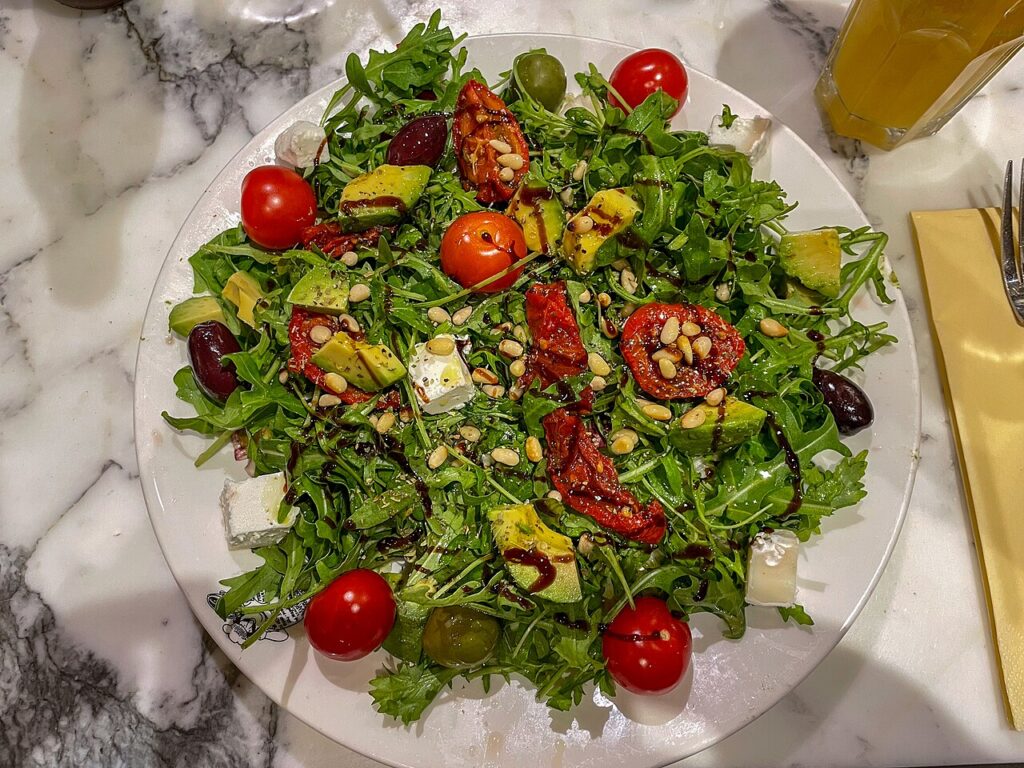
They are eaten raw in salads, dressed with olive oil and lemon, or added at the end of cooking to soups, pasta or a tagine to preserve the heat-sensitive sulphur compounds. A typical portion is a generous handful (about 30 to 50 g) per meal. Always wash the leaves thoroughly before eating.
Seeds
Sold by herbalists, they are traditionally ground and mixed into honey or a hot drink, at about one teaspoon a day. They are also used to prepare hair poultices mixed with a little lukewarm water. Their flavour is very sharp: start with small amounts.
Seed oil (external use)
This is the form most often used for hair. The traditional routine is as follows:
- Apply a few drops to a dry or slightly damp scalp, section by section.
- Massage with your fingertips in circular movements for 5 to 10 minutes.
- Leave on for 30 minutes to 1 hour (or overnight under a towel for an intensive treatment).
- Rinse with a mild shampoo, working the shampoo into the oil before wetting the hair.
- Repeat 1 to 2 times a week, over a 2- to 3-month course, to hope for a visible effect.
The oil’s sulphurous smell is strong but disappears when rinsed; many people dilute it in a more neutral oil (argan, olive, castor). Always do a skin test in the crook of the elbow 24 hours before the first application.
Arugula precautions and contraindications
- Anticoagulant treatment: its high vitamin K content can interfere with vitamin K antagonists (warfarin, acenocoumarol, fluindione). The aim is not to cut out the plant, but to keep intake stable and regular, and to inform your doctor.
- Infants and very young children: the nitrate content of leafy vegetables exposes very young children to a risk of methaemoglobinaemia. Avoid giving large amounts to infants.
- Thyroid disorders: like all Brassicaceae, it contains goitrogenic compounds. Normal dietary consumption is not a problem, but people on thyroid treatment should avoid very large amounts and talk to their doctor.
- Pregnancy and breastfeeding: the leaves remain a food. However, the therapeutic use of the seeds or oil is not documented in this context: refrain without medical advice.
- Oxalate kidney stones: the plant contains oxalates. People prone to kidney stones should limit large, repeated portions.
- Allergies: rare, but possible in people sensitive to Brassicaceae. Stop if itching, redness or digestive discomfort occurs.
- Internal use of the oil: the seed oil is rich in erucic acid, the consumption of which in large amounts is subject to regulatory limits. Reserve it for external use unless a professional advises otherwise.
FAQ: your questions about arugula
Does arugula oil really make hair grow back?
It is traditionally used for this purpose in Morocco and throughout the Maghreb, and many users report stronger, shinier hair. However, there is no good-quality clinical trial to confirm that it stimulates regrowth. In cases of heavy, persistent or localised hair loss, a medical consultation is essential to identify the cause (iron deficiency, thyroid disorder, androgenetic alopecia, etc.).
What is the difference between jarjir and hab rchad?
They are two different Brassicaceae that are often confused. Jarjir refers to arugula (Eruca sativa), whereas hab rchad refers to garden cress seeds (Lepidium sativum). Both have a sharp taste and similar traditional uses, but their composition and precautions for use are not the same.
Can you eat it every day?
Yes, as part of a varied diet and in reasonable portions, for a healthy person. The rule of caution is the same as for all leafy vegetables: vary your sources rather than eating very large quantities of a single food, especially if you are on anticoagulant treatment or have a history of kidney stones.
Conclusion
Arugula holds a special place in the Moroccan pharmacopoeia: an everyday vegetable through its leaves, a traditional hair remedy through its oil. Its nutritional density — glucosinolates, vitamin K, beta-carotene, minerals — makes it a worthwhile addition to the plate, while its seed oil remains a popular external treatment, to be used methodically and regularly. As always in herbal medicine, effectiveness depends less on the dose than on consistency, and caution is advised for anyone taking medication.
Further reading
- Full botanical profile of arugula (Wikipedia).
- Garden cress (Hab Rchad): benefits, dosage and precautions — the plant most often confused with jarjir.
- Nettle: benefits, dosage and precautions — another plant traditionally associated with healthy hair.
- Argan oil: benefits, dosage and precautions — the ideal oil for diluting and softening a hair treatment.
This article is provided for information purposes only and in no way replaces medical advice. Ask your doctor or pharmacist for advice before starting a course, particularly if you are undergoing treatment, are pregnant or breastfeeding, or have a chronic condition.