Basil (lhbaq in Darija, حبق in Arabic) is one of the most common aromatic plants in Moroccan homes: grown in pots on rooftop terraces for its scent, tossed into salads, or sipped as an infusion after a hearty meal. Behind this everyday use lies a genuine medicinal plant of the Lamiaceae family, rich in essential oil and polyphenols. Here is what we know about its composition, benefits, dosage and the precautions to follow.
What is basil (lhbaq)?
Sweet basil, Ocimum basilicum L., belongs to the Lamiaceae family, the same family as thyme, oregano, mint and rosemary. In our climate it is an annual herbaceous plant, 20 to 60 cm tall, with upright square stems and oval to lance-shaped leaves 2 to 4 cm long, ranging from pale to dark green depending on the variety. Its small white, two-lipped flowers are grouped in elongated spikes.
Native to South Asia or Central Africa, the plant was introduced to Egypt at least 4,000 years ago, then to Rome and throughout southern Europe. Its name comes from the Late Latin basilicum, “royal”, itself derived from the Greek basilikón, “royal plant”. In Arabic it is called habak or hbak, which gave the Spanish word albahaca, inherited from Andalusian Arabic.
In Morocco, basil is mainly grown as an aromatic plant indoors and on terraces, prized for its sweet fragrance and its reputation for keeping mosquitoes away. It is also sold dried by herbalists under the name hbak.
Composition and active compounds of basil
Basil’s richness lies first and foremost in its essential oil, obtained by steam distillation of the flowering tops. It takes about 10 kg of plant material to produce 10 ml of essential oil. Its composition varies greatly depending on the chemotype, the season and where it is grown.
- Linalool: about 12 to 14% of the essential oil, and up to 80% in some Mediterranean chemotypes. An antispasmodic and calming molecule.
- Eugenol: around 20% depending on the chemotype, known for its anti-inflammatory and antiseptic action.
- Methyl chavicol (estragole): dominant in the Indian chemotype, where it can reach 90%.
- 1,8-cineole (eucalyptol), ocimene, limonene, methyl cinnamate: other volatile compounds frequently identified.
- Polyphenols: rosmarinic acid, caffeic acid, flavonoids (quercetin, kaempferol) and tannins.
- Nutrients: the leaves provide vitamin K, iron and antioxidant compounds.
This diversity explains why two basils from different origins can have very different scents and activity profiles.
7 benefits of basil
Much of what basil is used for comes from tradition and from in vitro or animal studies. Clinical data in humans remain limited, so these benefits should be read as traditional uses worth exploring, not as therapeutic promises.
1. It supports digestion
This is its best-documented use. Basil is traditionally used as a stomachic and carminative, as a supportive treatment for bloating and flatulence, to aid digestion and stimulate the appetite. Hence the habit of drinking an infusion after a heavy meal.
2. An antispasmodic action
Linalool gives the plant an antispasmodic effect on the digestive tract, which is put to use against stomach cramps. In homeopathy, the fresh leaves are in fact used to prepare a tincture taken as an antispasmodic.
3. Antioxidant potential
Basil’s polyphenols, particularly rosmarinic acid and flavonoids, show antioxidant activity in laboratory tests. These compounds help counter oxidative stress, which is involved in cellular ageing.
4. Antibacterial and antifungal properties
All the cultivars studied show anti-infective, antibacterial and antifungal activity in vitro. In herbal medicine, the plant is indicated as an antiseptic and anti-inflammatory for the digestive and urogenital tracts.
5. Nervous relaxation and headaches
Basil is used as a mild nervous sedative. In Morocco, basil infusions are popular for easing headaches, coughs and digestive complaints — three indications that come up regularly in local herbal practice.
6. Comfort during menstruation
The combination of linalool’s antispasmodic action and eugenol’s anti-inflammatory action makes the plant of interest for mild to moderate dysmenorrhoea, as a complement to treatment rather than a substitute for it.
7. A natural mosquito repellent
Basil essential oil has insecticidal properties, notably against mosquito larvae. This explains why a pot of hbak is almost always found on Moroccan windowsills in summer.
How to use basil: directions and dosage
As an infusion
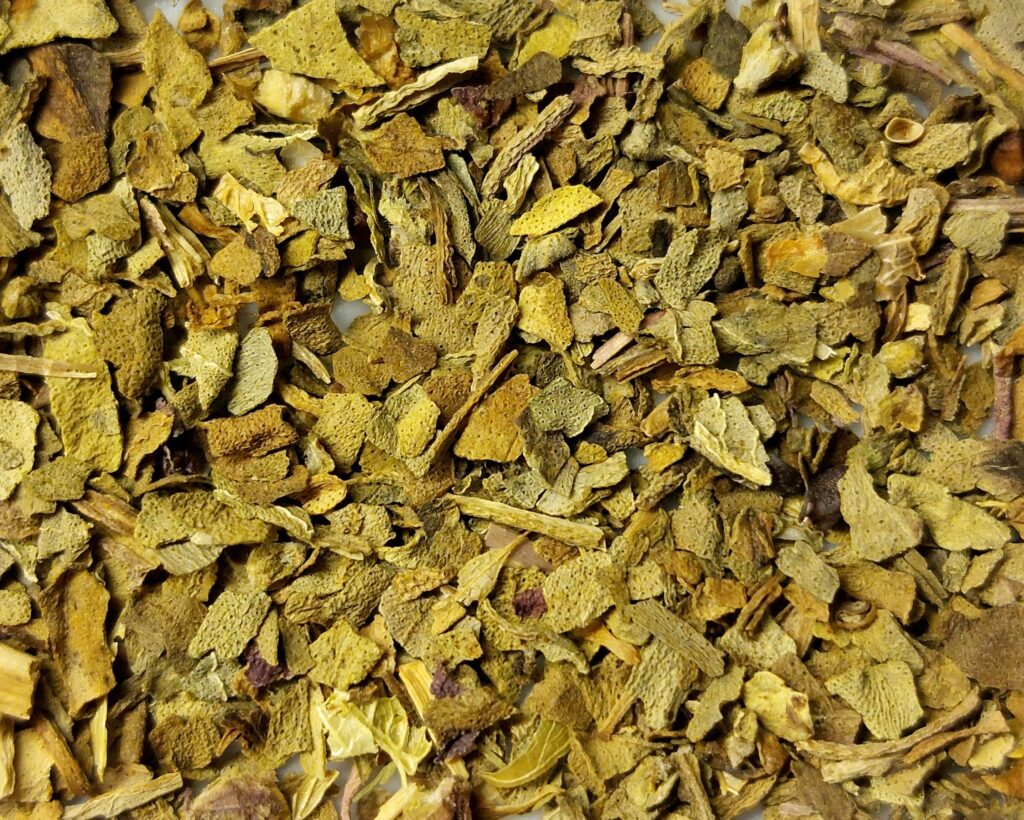
This is the simplest and safest form. Use one teaspoon of dried leaves, or about ten fresh leaves, per 250 ml of boiling water. Cover and steep for 10 to 15 minutes to retain the volatile compounds, then strain. Traditionally, one cup is taken after meals, with no more than two to three cups a day, over short courses.
In cooking
The leaves are best used raw, as their aroma fades with cooking. They go well with salads, tomatoes, courgettes, fish, eggs and olive oil sauces. Occasional culinary use in small amounts poses no particular problem.
As an essential oil
The essential oil is vastly more concentrated than an infusion and calls for supervised use. It should never be applied neat to the skin or swallowed without advice from a health professional trained in aromatherapy, and its profile depends on the chemotype (linalool, methyl chavicol, eugenol…).
Precautions and contraindications
- Pregnancy: the plant is thought to stimulate uterine contractions. Drinking infusions regularly is not recommended, especially in early pregnancy. Occasional culinary use carries no known risk.
- Breastfeeding and essential oil: the essential oil is not recommended during pregnancy and breastfeeding.
- Basil seeds: as a precaution, they are not recommended for pregnant or breastfeeding women.
- Estragole: this compound, potentially toxic at high doses, mainly concerns essential oils from exotic or tropical basil. The issue does not arise in the same way for an infusion of dried leaves, which is far less concentrated.
- Toxicity at high doses: in rats, Ocimum basilicum essential oil given at 1,500 mg/kg per day for 14 days caused damage to the stomach lining and the liver, in a dose-dependent manner.
- Anticoagulant treatment: the vitamin K content of the leaves calls for caution in people taking vitamin K antagonists.
- Allergies: avoid in case of known allergy to Lamiaceae.
If you have a chronic illness or take long-term medication, and for children or older people, ask a doctor or pharmacist for advice before starting any course.
FAQ: your questions about basil
Does basil help you lose weight?
No. No slimming properties have been demonstrated. Basil can simply improve digestive comfort and add flavour to light dishes, which indirectly helps you eat in a more balanced way — but it does not make you lose weight on its own.
Can you drink basil tea every day?
In traditional use, a cup after meals is common. It is still better to take it in short courses rather than continuously all year round, and to seek professional advice if you are pregnant, on medication or have a chronic condition.
What is the difference between sweet basil and holy basil (tulsi)?
They are two distinct species of the same genus. Sweet basil is Ocimum basilicum, the one found in our kitchens and on our balconies. Holy basil, or tulsi, is Ocimum tenuiflorum (formerly Ocimum sanctum), a ritual and medicinal plant in India with a different compound profile and different uses.
Conclusion
Basil is a good example of a plant we think we know because we cook with it every day. Its compounds — linalool, eugenol, rosmarinic acid — give it a digestive, antispasmodic and antioxidant profile consistent with its traditional use in Morocco. As long as you stick to infusions and the plate, and leave the essential oil to professionals, basil remains a simple, accessible and well-tolerated plant.
Further reading
- Basil — full botanical profile on Wikipedia
- Oregano: benefits, dosage and precautions
- Lemon balm: benefits, dosage and precautions
- Spearmint: benefits, dosage and precautions
This article is for information only and does not replace medical advice. Consult a doctor or pharmacist before starting any course, particularly if you are pregnant, breastfeeding, taking medication or have a chronic condition.