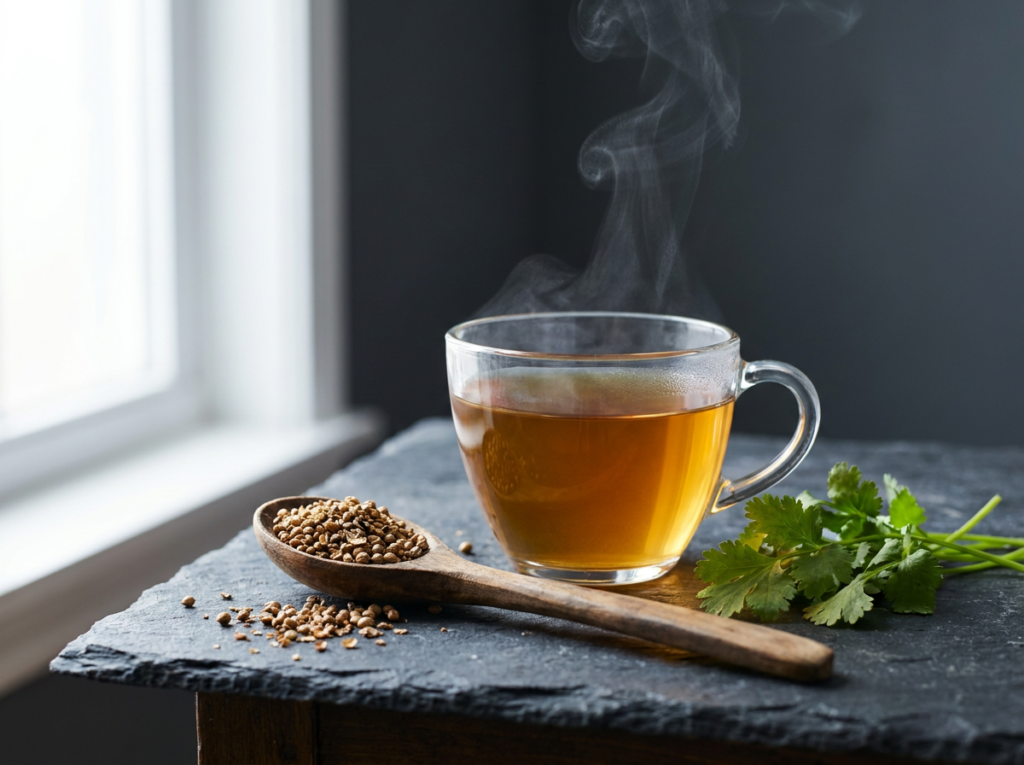
Coriander is one of the most common aromatic plants in Moroccan kitchens and herbal shops, where it is known as qesbour for its leaves and qazbara for its seeds. Behind its everyday culinary use lies a medicinal plant whose traditional use for mild digestive complaints is recognised by European health authorities. This guide reviews its composition, benefits, how to use it and the precautions to be aware of.
What is coriander?
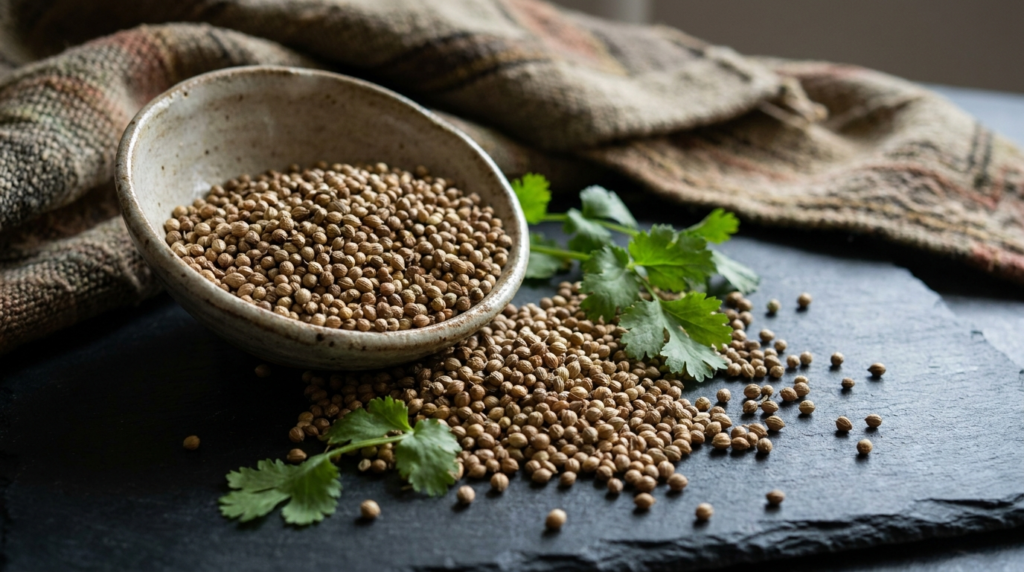
Coriander (Coriandrum sativum L.) is an annual plant of the Apiaceae family, the same family as cumin, fennel, aniseed and caraway. It grows 30 to 70 cm tall, produces small umbels of white or pinkish flowers, and then spherical fruits about 3 to 5 mm across that are loosely called “seeds”.
Two quite distinct parts are used, and it is essential not to confuse them. The fresh leaves, highly fragrant, are used in cooking and provide vitamins and antioxidants. The dried fruits, with their warm, lemony aroma, are the true herbal drug of phytotherapy: they are the part covered by a traditional-use monograph.
Native to the eastern Mediterranean basin, coriander has been grown in Morocco for centuries, particularly in the Gharb, Haouz and Souss regions. It is one of the country’s major aromatic and medicinal crops, alongside cumin, aniseed and parsley.
Composition and active compounds of coriander
The therapeutic value of the fruits lies above all in their essential oil, present in low concentration but highly characteristic.
- Linalool: by far the dominant monoterpene in the essential oil of the fruits, accounting for around 60 to 80% of the volatile compounds depending on the analysis. It is responsible for most of the antispasmodic and carminative activity.
- Other terpenes: gamma-terpinene, alpha-pinene, camphor, geraniol and geranyl acetate, in smaller proportions.
- Fatty acids: the fruits contain a fatty oil rich in petroselinic acid, a fatty acid that is uncommon in the plant kingdom.
- Polyphenols and flavonoids: notably quercetin and phenolic acids, responsible for the antioxidant activity measured in vitro.
- Fibre, minerals and vitamins: the fresh leaves provide vitamin K, vitamin C, beta-carotene and minerals.
This composition explains why coriander is classed among the carminative plants: volatile substances that relax the smooth muscle of the intestine and help expel gas.
The benefits of coriander
1. Relieving bloating and gas
This is the best-established indication. The Committee on Herbal Medicinal Products (HMPC) of the European Medicines Agency has recognised the fruits of Coriandrum sativum as a traditional herbal medicinal product for the symptomatic treatment of minor digestive complaints: bloating, flatulence and a feeling of heaviness after meals. This recognition is based on the long-standing and consistent use of the plant, not on large-scale clinical trials.
2. Easing digestive spasms
Pharmacological studies in animals and on isolated intestinal segments show that the linalool-rich essential oil has a relaxing effect on the smooth muscle fibres of the intestine. In practice, the infusion is traditionally used to calm mild abdominal cramps and sluggish digestion.
3. Stimulating appetite and digestive secretions
Like most aromatic bitters, coriander is traditionally used to whet the appetite and support gastric and bile secretions. This is one of the reasons it is found in the Moroccan spice blends served with rich or fatty dishes.
4. A worthwhile antioxidant contribution
The polyphenols and beta-carotene in coriander show antioxidant activity in laboratory models. Eaten fresh as a seasoning, it makes a modest but regular contribution to the daily intake of protective compounds, as part of a varied diet.
5. Anti-inflammatory action under study
Linalool is the subject of preclinical research into its anti-inflammatory, analgesic and neuroprotective properties. These studies, carried out in animal models, are encouraging but do not yet allow any therapeutic recommendation to be made for humans.
6. Fresher breath
Chewing a few dried fruits after a meal is a common traditional habit in the Maghreb and in India. The aromatic essential oil masks odours, and chewing stimulates salivation.
7. Everyday support for digestive comfort
Combined with cumin, fennel or aniseed, coriander is part of many family digestive teas. These combinations follow a common logic: bringing together several carminative plants with complementary aromatic profiles.
How to use it and dosage
The fruits should be lightly crushed in a mortar just before use: the essential oil is volatile and degrades on contact with air. Buy them whole rather than ground, and store them in an airtight container away from light.
- Infusion: about 1 teaspoon of crushed fruits (2 to 3 g) in 250 ml of boiling water, covered, for 10 minutes. Two to three cups a day, after meals.
- Light decoction: 10 to 30 g of fruits per litre of water, simmered briefly and then left to steep.
- Fresh leaves: add raw at the end of cooking to preserve the aromas and vitamin C.
- Essential oil: for adults only, on professional advice, in short courses of a few days. Never undiluted on the skin, and never for prolonged use without supervision.
In traditional use, a course generally does not exceed two weeks. If digestive complaints persist beyond that, medical advice is needed.
Precautions and contraindications
At food doses and as an infusion, coriander is well tolerated by most adults. A few situations nevertheless call for caution.
- Allergies: cross-reactions are possible in people allergic to Apiaceae (celery, carrot, fennel, anise). Contact dermatitis has been reported in people who handle it regularly.
- Pregnancy and breastfeeding: culinary use is not a problem, but concentrated preparations and the essential oil are not recommended due to insufficient data.
- Children: concentrated forms and the essential oil are not suitable for young children.
- Ongoing treatments: if you are taking antidiabetic, blood-pressure-lowering, diuretic or anticoagulant medication, ask your doctor or pharmacist before regular use as a course.
- Photosensitivity: some Apiaceae contain photosensitising compounds; avoid sun exposure after applying the essential oil to the skin.
As with any plant bought loose, choose a traceable source. Surveys of Moroccan herbal shops highlight the importance of reliable botanical identification and proper storage conditions.
Coriander FAQ
What is the difference between the leaves and the seeds?
The fresh leaves are a condiment rich in vitamins and antioxidants, with a sharp aroma. The dried fruits, milder and lemony, concentrate the linalool-rich essential oil and are the part used in digestive phytotherapy.
Can you drink it every day?
One to three cups of infusion a day for one to two weeks corresponds to common traditional use. Beyond that, it is better to alternate with other digestive plants and to check in with a professional if symptoms persist.
Why do some people think coriander tastes like soap?
This well-documented perception is linked to genetic variations in olfactory receptors that make some people particularly sensitive to the aldehydes in the fresh leaves. The dried fruits, which have a different aromatic profile, are generally well accepted by these same people.
Conclusion
Somewhere between an everyday condiment and a digestive tea, coriander holds a discreet but solid place in the Moroccan pharmacopoeia. Its use against bloating and mild digestive discomfort is the one with the strongest official recognition; other avenues, notably anti-inflammatory and antioxidant ones, are still at the research stage. An infusion of crushed fruits after a meal remains the simplest and safest way to benefit from it.
Further reading
- Coriander (Coriandrum sativum) — full botanical profile on Wikipedia
- Cumin: benefits, dosage and precautions
- Fennel: benefits, dosage and precautions
- Aniseed: benefits, dosage and precautions
- Caraway: benefits, dosage and precautions
This article is for information only and does not replace medical advice. In case of persistent symptoms, pregnancy, breastfeeding or ongoing treatment, consult a doctor or pharmacist before using a medicinal plant.