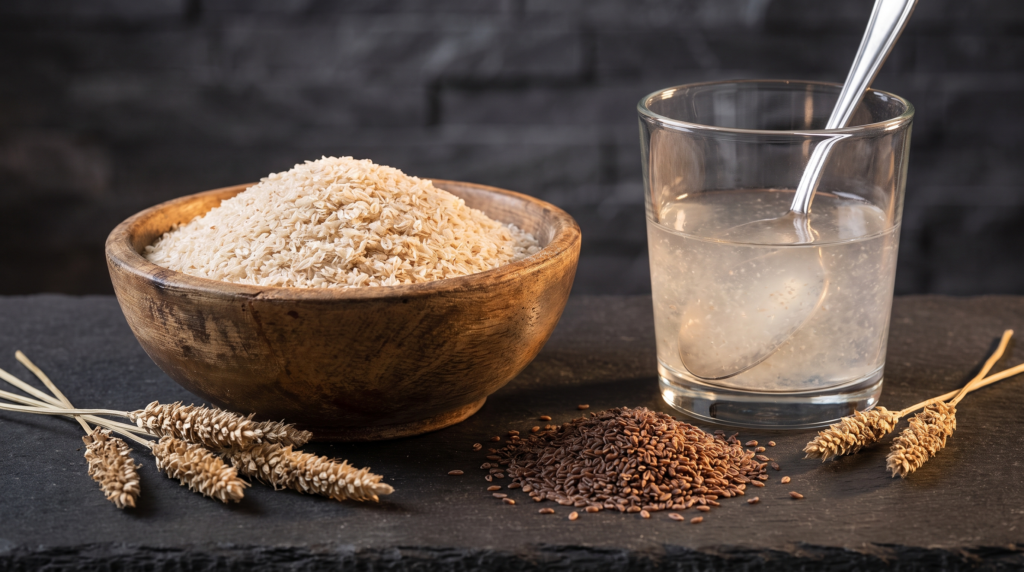
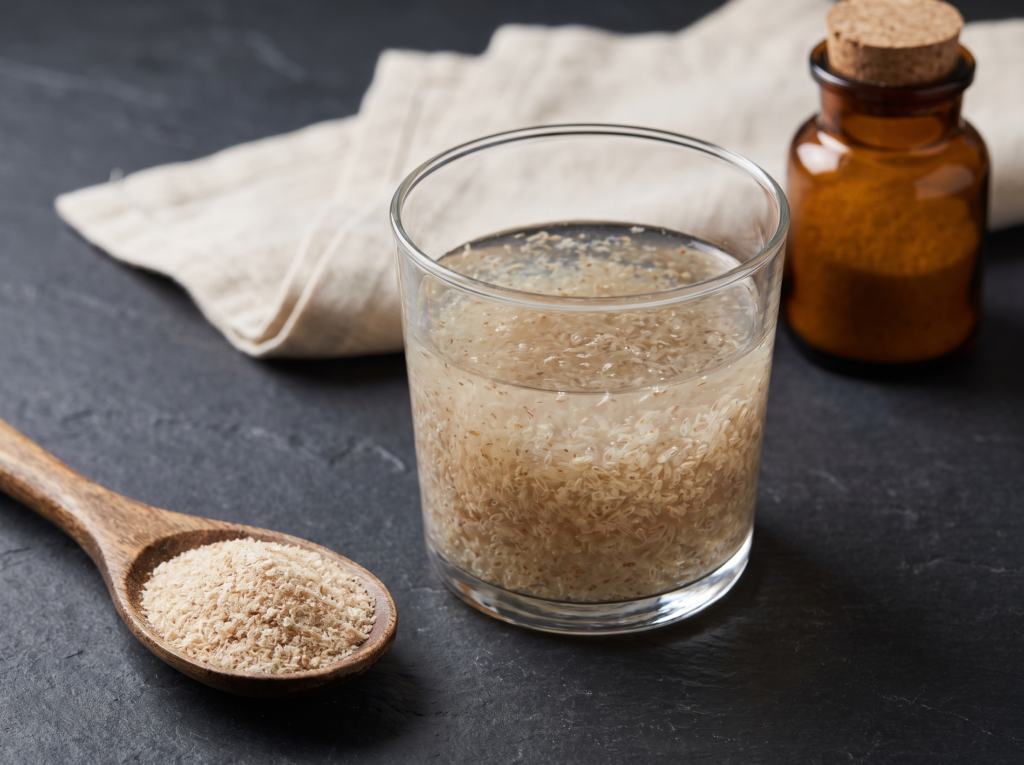
Psyllium has become one of the most widely used natural fibres in Morocco for restoring regular bowel movements without irritating the gut. Known in herbal shops as ispaghul or “bezr qatouna”, it is the husk (seed coat) of the seed of Plantago ovata, a herbaceous plant grown mainly in India and Pakistan. What makes it special is a very simple mechanism: on contact with water, it swells and forms a viscous gel that works mechanically in the digestive tract, with no stimulant or irritating substance.
What is psyllium?
Psyllium refers to the seeds, and above all the husk, of certain species of the genus Plantago, in the Plantaginaceae family. These plants are close relatives of the plantains found in fields, but their tiny seeds hold a remarkable amount of soluble fibre called mucilage.
Its use goes back several thousand years in traditional Indian, Persian and Arab-Islamic medicine, where it was already used as a gentle laxative and to protect the digestive lining. Today, it can be found in Moroccan herbal shops as whole seeds, as husks (a light, blond powder) or as a fine powder included in dietary supplements.
Blond psyllium or black psyllium: what’s the difference?
Two forms are available on the market:
- Blond psyllium (ispaghul): from Plantago ovata, it is the most common and the richest in mucilage. It is the one most usage recommendations refer to.
- Black or brown psyllium: from Plantago afra (or Plantago psyllium), more Mediterranean, it contains less mucilage and its action is somewhat milder.
In practice, when people talk about psyllium for digestive comfort, they almost always mean blond psyllium.
Composition and active compounds of psyllium
Psyllium’s strength does not come from an active molecule in the classic sense, but from its physical structure. The husk is made up mostly of dietary fibre, the large majority of it soluble.
- Mucilage: the husk contains between 20% and 30%. These are complex polysaccharides (mainly arabinoxylans) that bind water.
- Insoluble fibre: cellulose and hemicelluloses, present in smaller proportions, which add bulk to the stool.
- Protein and minerals: in marginal amounts, since psyllium is not eaten as a nutritious food but as a functional fibre.
- Very few absorbable calories: mucilage is not digested by human enzymes and passes through the small intestine intact.
On contact with water, this mucilage soaks up liquid and forms a gel that coats the intestinal lining. It is this gel — not a chemical effect — that explains all the properties attributed to the plant.
The health benefits of psyllium
1. A two-way bowel regulator
This is the best-documented property. In case of constipation, the gel increases stool volume and retains water: stools become softer and easier to pass, with no irritating effect on the intestinal wall. Conversely, when stools are too loose, the same gel absorbs excess water and gives the intestinal contents more consistency. For this reason, it is described as a “regulating” fibre rather than a laxative in the strict sense.
2. A well-tolerated bulk-forming laxative
Unlike stimulant laxatives, which force the colon to contract and can lead to dependence, psyllium works simply through a bulking effect. It does not cause dependence and can be used over long periods, provided you stay well hydrated.
3. Comfort for irritable bowel
Soluble fibre is generally better tolerated than insoluble fibre by people with irritable bowel syndrome. The gel it forms lubricates the passage and smooths out the swings between diarrhoea and constipation. Tolerance does vary from person to person, however: in some people, introducing it too quickly causes bloating.
4. An effect on blood sugar after meals
By increasing the viscosity of the digestive contents, psyllium slows gastric emptying and the absorption of carbohydrates. The result is a more gradual rise in blood sugar after a meal. This is a benefit often cited for people who keep an eye on their blood sugar balance, though it does not replace treatment or medical follow-up.
5. An action on cholesterol
The mucilage gel traps some of the bile acids in the gut and increases their elimination in the stool. To rebuild its stock of bile acids, the body draws on circulating cholesterol. Several studies have observed a drop in total and LDL cholesterol with a regular intake of soluble fibre.
6. Satiety and weight management support
Taken with a large glass of water before a meal, psyllium takes up space in the stomach and prolongs the feeling of fullness. It does not make you lose weight on its own, but it can help limit snacking as part of a balanced diet.
7. Support for the gut microbiota
Part of the mucilage is fermented by bacteria in the colon, which gives it a prebiotic character. This fermentation remains moderate compared with other fibres, which explains why psyllium is often better tolerated than inulin or FOS by sensitive guts.
How to use psyllium and dosage
How to prepare it
The rule is always the same: plenty of water. Pour the dose of husks into a large glass of water (250 to 300 ml), stir, drink immediately before the mixture thickens, then drink a second glass of water. You can also add it to yoghurt, fruit compote, soup or bread dough, as long as you make up for it with enough fluid intake.
How much per day?
- For bowel comfort: about 5 to 10 g of husks per day, split into 2 to 3 doses.
- For an effect on blood sugar or cholesterol: the amounts cited go up to about 10 g per day, always split.
- Getting started: begin with one teaspoon per day for a few days, then increase gradually. This slow build-up greatly reduces bloating.
- When to take it: preferably away from meals and, above all, away from medication.
The effects on bowel movements are not immediate: it usually takes one to three days of regular use before you notice a change.
Psyllium precautions and contraindications
Psyllium is generally well tolerated, but a few rules are non-negotiable.
- Never take it without enough water. Taken dry or with too little liquid, it can form a plug and cause an obstruction of the oesophagus or intestine.
- Digestive contraindications: intestinal obstruction or partial obstruction, narrowing of the digestive tract, abdominal pain of unknown origin, difficulty swallowing. In these situations, it must be avoided.
- Drug interactions: the gel can reduce the absorption of certain medicines (thyroid treatments, antidiabetic drugs, anticoagulants, lithium, iron, some antibiotics). Leave at least 2 hours between psyllium and any medication.
- Treated diabetes: by altering sugar absorption, it may require an adjustment of treatment. Medical advice is essential.
- Pregnancy, breastfeeding and children: ispaghul-based supplements are not recommended for pregnant or breastfeeding women or for children without medical advice.
- Common side effects: bloating, gas and a feeling of heaviness at the start of a course. They are harmless and usually fade within a few days.
- Allergy: rare but possible, especially in people regularly exposed to the powder.
If constipation persists for more than two weeks, or comes with blood in the stool, weight loss or significant pain, a medical consultation is essential.
FAQ: your questions about psyllium
Does psyllium help you lose weight?
No, not directly. It acts neither on stored fat nor on metabolism. Its benefit is indirect: the gel it forms increases satiety and can help reduce the amounts eaten. Without a balanced diet and physical activity, the effect on weight remains negligible.
Can you take psyllium every day and over the long term?
Yes, it is a bulk-forming laxative that does not cause dependence, unlike stimulant laxatives. Daily use is possible if you drink enough and keep the dose reasonable. If you are on long-term medication, talk to your doctor or pharmacist.
What’s the difference between psyllium and flaxseed?
Both are rich in mucilage and act on bowel movements. Flaxseed also provides omega-3 fatty acids and lignans, but it must be ground to be effective and goes rancid quickly. Psyllium, on the other hand, is more concentrated in soluble fibre, contains no fat, and keeps for a long time as dry husks.
Key takeaways about psyllium
Psyllium is a simple fibre, with no complex active molecule, whose entire effectiveness rests on its ability to form a gel. This mechanism allows it to regulate bowel movements in both directions, bring comfort to sensitive guts, smooth out blood sugar after meals and contribute to cholesterol management. Its excellent tolerance profile makes it one of the most accessible natural remedies — provided you follow the golden rule: always plenty of water, a gradual increase in dose and a two-hour gap from medication.
Further reading
- Botanical profile of Plantago ovata on Wikipedia
- Flaxseed: benefits, dosage and precautions
- Mallow (Khoubiza): benefits, dosage and precautions
- Spirulina: benefits, dosage and precautions
This article is provided for information only and in no way replaces medical advice. Ask your doctor or pharmacist for advice before any use, especially if you are undergoing treatment, have a digestive condition, or are pregnant or breastfeeding.